staples

How to make shuumai / shumai dumplings

ebishuumai480.jpg

Shuumai or shumai dumplings (焼売)are a standby for dim sum, and are very well suited to bentos. They are small, taste good cold, freeze very well, and are a lot easier to make than gyoza dumplings.

You’ve probably encountered shuumai dumplings in the freezer section of Asian or Japanese grocery stores. Frozen ones are usually pretty good, but if you make them yourself you know exactly what you put in them. I just make a double batch whenever I decide to make shuumai for dinner. Just follow along with the photos and you’ll be turning out lots of shuumai yourself. continue reading...

Roasted carrot spread

carrot_spread.jpg

I do love carrots. They are full of nutrients and fiber, inexpensive, available year around, and durable. And their bright orange color (or other colors, if you delve into the exotic varieties) add instant cheer to any dish or bento box. So when I saw that my favorite vegan author Yumiko Kano was coming out with a new book of just carrot recipes, I reserved it in advance without a second thought.

This is a recipe adapted from that book. It’s a soft, light carrot spread or paste that is sweet, salty and a bit spicy. It has tahini (sesame seed paste) in it, which adds richness as well as protein. The spiciness comes from cumin and red chili pepper powder, and the sweetness comes from the carrot itself, which is roasted to intensify the flavor, and a tad of raw cane sugar. It is great as a spread on crackers or rice cakes or toast, or as a dip. The soft texture means it can’t quite substitute for peanut butter in a pb and j sandwich, but it’s fantastic in a wrap sandwich. It is of course totally gluten-free and nut-free too, so if your child’s school has a “no-nut” policy, which seems to be increasingly common these days, this is great. continue reading...

Individual portion frozen shepherd's pies (or any kind of casserole dish)

indivsheppie.jpg

This is more of a tip than a recipe, but I’ve put it here because it’s a handy way of building up your bento freezer stash. When I make something that is baked in a casserole for dinner such as shepherd’s pie, I try to make a few individual portions in cupcake liners. continue reading...

Bento item of the week: Microwaveable no refrigeration needed rice

takitakegohan.jpg

This week’s bento item of the week is something that goes into a bento box for a change - microwaveable rice. continue reading...

Homemade furikake no. 9: Green tea

furikake_tea1_480.jpg

We used to have a neighbor lady in Japan who came from Shizuoka, a major tea growing region. She used to say that at her parents’ house they used to eat tea leaves sprinkled with salt as a snack. At the time, the cynical kid that was me thought that sounded disgusting! But then I was recently surfing around some Japanese sites and stumbled upon the home page of a tea producer, who mentioned the same thing. They also said that they enjoyed tea as furikake.

The site didn’t have a recipe, but they mentioned putting in chirimenjako (tiny salted fish, which I used in the hijiki seaweed furikake) and sakuraebi (tiny dried shrimp), used in Furikake no. 1, radish leaves.) Both are dried or semi-dried products that are packed with umami, and are also high in calcium. You can get them at any Japanese grocery store, and very similar products are available at general Asian or Chinese stores too. In case you can’t get a hold of them though, I’ve given some variations below, including a vegan one.

The tea furikake definitely has the taste and fragrance of tea (with a hint of bitterness), enhanced by the umami of the other ingredients. It’s really very pleasant. Tea furikake is not available commercially as far as I know (at least not outside of Japan). And if drinking the extract of tea leaves is so healthy, surely eating tea leaves has to be as good, if not better! continue reading...

Basic meat and tofu mixture for mini-burgers, meatballs and more

miniburgerplate_450.jpg

I spent about an hour on Sunday making and cooking up a big batch of a basic burger mixture. The mix is very versatile, so I made four different things from it. Now I have enough mini-burgers, meatballs and more in my freezer for at least 20 or more bento portions. It was an hour well spent! I love just knowing that my freezer has a nice stock of ready-to-go bento items - it takes the pressure off considerably on busy mornings. continue reading...

Homemade furikake no. 8: Hijiki and chirimenjako (tiny tiny fish)

hijki furikake image

I’m cheating a bit here since this recipe has been featured already on Just Hungry. But it did get rather buried in a general article about seaweed, so here it is again in the Homemade Furikake series.

This combines hijiki, which is full of fiber and minerals, with chirimenjako, tiny little whole salted fish. You can find both at Japanese grocery stores, and Chinese grocery stores carry something similar. Since they are whole fish, they are full of calcium, and also pack a lot of umami. Many Japanese people are lactose intolerant, so they get their calcium by eating things like chirimenjako. continue reading...

Homemade furikake no. 7: Salmon furikake (or Sake flakes)

furikake7_sake450.jpg

Is this salmon (sake) furikake? Or is it salmon (sake) flakes? Or maybe it’s even salmon soboro. Whatever you call it, it’s finely flaked salmon that you can sprinkle onto plain rice, use as an onigiri filling, or on ochazuke. You could fold it into egg for a salmon omelette, on boiled vegetables…whatever your imagination can come up with.

Salmon flakes are often sold in jars that cost around $8 for about 150g. You can make it yourself for less than $3, depending on how expensive the salmon is. You can be even more frugal and use the little bits that are stuck on the bones when you filet a whole salmon. This is probably how fish soboro or flakes or furikake was invented in the first place. continue reading...

Basic meat soboro, a great bento staple

niku_soboro.jpg

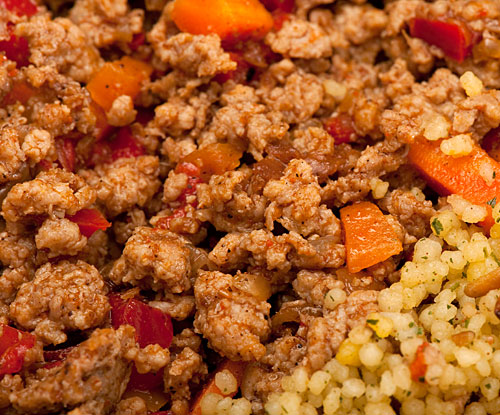
A soboro is rather like furikake, except that it’s moister. It’s used like furikake in many situations - sprinkled onto rice, folded into other things like eggs, and more. Soboro can be made of ground meat, flaked fish (though fish soboro is often called oboro instead), or egg (egg soboro is often called iri tamago, just to keep you confused!) Meat soboro (niku soboro) keeps for about a week in the refrigerator, and freezes beautifully, making it a great bento johbisai or staple for the omnivore. continue reading...

Stewed hijiki seaweed with carrots and fried tofu

hijiki_nitsuke_450.jpg

This is a very classic Japanese staple dish. More often than not, I have some variation of it in my refrigerator. The base is hijiki seaweed, which is soaked and reconstituted then cooked in dashi with various other ingredients that give it flavor. It’s great to add to a bento box.

This version has carrots and fried tofu in it. Cutting them into fancy shapes is totally optional, but it does make your bentos a bit more fun.

I’ve used me-hijiki for this but you can use the regular long branch hijiki too. continue reading...

Homemade furikake no. 6: Gomashio, sesame salt

furikake6_gomashio450.jpg

Gomashio (ごま塩), sesame salt, is the most basic furikake. This is the best way I know to make homemade gomashio, where each sesame seed is coated with its own fine salt mantle. continue reading...

Homemade furikake no. 5: Sweet bacon

furikake5_sweetbacon450.jpg

I’ve neglected the furikake series for a while, but it’s back!

And what better way to return, than with bacon.

I have bacon on the mind recently for some reason. I’m not overindulging in it, but it’s fun trying to figure out different ways of incorporating bacon in one’s life.

Bacon goes with everything, including rice. It’s salty and bacon-y. I’ve souped it up by adding some Japanese flavors sweet-salty flavors. The result is almost like bacon candy. A little goes a long way.

It’s great sprinkled on just about everything. Besides rice, you could sprinkle it on eggs, vegetables, your tongue… continue reading...

And while we're at it...what are your favorite bento staples?

instant tsukemono mixI mentioned a few bento-oriented staples to keep around in my previous post about maintaining variety in your bentos. I’ve just done a quick look around my kitchen, and here are the things I have stocked as staples that I bought or made with future bentos in mind, besides the things I’ve mentioned already.

continue reading...

Homemade furikake no. 4: Spicy curry peanut

furikake4_currypn450.jpg

Warning: This furikake is very dangerous. It is so more-ish that you might find yourself putting spoonfuls of it directly in your mouth. To prevent this, I recommend making it a tad spicier than you might be comfortable with eating it on its own, so it will not disappear before you can use it on your rice. The spicy-salty-sweet taste, coupled with the interesting textures of the peanuts and the seeds, is quite hard to resist.

It’s the least Japanese-tasting furikake so far perhaps, but it fits plain white or brown rice very well. It is not exactly low-calorie, but a tablespoon or so goes quite a long way to spice up things. continue reading...

Johbisai or Joubisai: Building up a bento making 'stash'

Anyone who does any kind of art or craft work is familiar with the concept of a stash. A knitter for example has a stash of different kinds of yarn. This really helps to get the creative juices flowing. In bento making terms, the equivalent of a stash is joubisai (or johbisai) (常備菜). Literally this means ‘always available food’. They are stored foods that can be kept for a while, which can be pulled out and used on short notice, and enrich and streamline the bento making process. continue reading...

Related sites

    » follow me on Twitter

    Just Bento is a site dedicated to healthy bento box meals.

    Causes we support

    wfp banner img
    freerice234_60_Banner2.jpg

    Subscribe

    Subscribe in a reader


    Subscribe by email:


    Or use your favorite web tool:
    Add to Google Reader or Homepage

    Add to netvibes
    Subscribe in Bloglines

    Share this site

    Add to Technorati Favorites

    stumbleupon