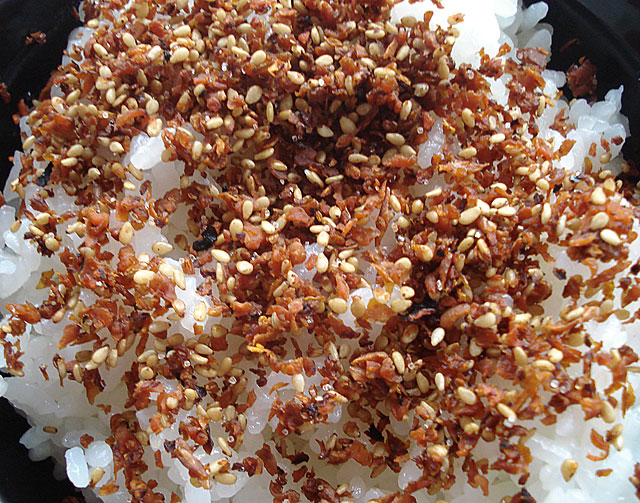
Carrots are a staple of just about everyone’s fridge I think. They are really good for you, but it can be rather hard to find different ways of eating them. This sweet, savory and spicy furikake uses up whole carrots as well as bits of carrot left over from other uses. Plenty of sesame seeds are added for flavor and texture - and they’re not bad for you either. The warm, brown-orange color perks up a dull looking bento, especially on white rice.
I do not subscribe to the Jessica Seinfeld ‘hiding vegetables in dubious ways in your food’ school of feeding your kids, but if they like furikake, it doesn’t hurt to try this on them.
Unlike most furikake recipes, this doesn’t have bonito flakes in it so is vegan.
Equipment: a large non-stick frying pan or sauté pan; food processor or grater
Peel and finely grate or chop the carrots - a food processor makes this go a lot faster.
Heat up the non-stick pan over low-medium heat. Put in the carrots, and let dry-cook slowly (kara iri), stirring occasionally, until it’s dried out quite a bit and has reduced to about 1/4th of its original volume. The drier the carrots, the longer the furikake will keep, but you can keep it at the slightly-moist stage as long as you’ll be using this up within a week or so. (This stage does take awhile (about 15-20 minutes) but you don’t have to watch it constantly.)
Add the soy sauce and stir rapidly until the liquid is evaporated. Using a light-colored soy sauce will help to preserve the orange color better, but a dark one will taste as good. Add sugar.
Shove the carrot aside to make a hole in the middle of the pan. Pour the sesame seeds in there and stir until a couple start to ‘pop’. Rapidly stir around and take off the heat.
Add the nanami tohgarashi. Sprinkle a bit onto some plain rice, and taste; if needs it, add a little salt and more nanami tohgarashi if needed.
Makes about 1/2 cup. Store (after it’s completely cooled) in an airtight container in the refrigerator, and try to use up within a week. It can be sprinkled on rice, soups, etc.
I use nanami tohgarashi quite a lot - it’s one of the staple ingredients in any Japanese kitchen. It has a complex flavor that is much more interesting than plain red chili pepper. But, is it nanami tohgarashi or shichimi tohgarashi? The kanji for it is 七味唐辛子; the 七味 part means “seven flavors”, and the 唐辛子 part means chili pepper. 七 is the kanji for seven, but it can be read as “shichi” or “nana”. I grew up calling it “shichimi”, but sometime in my teens one of my classmates’ mothers heard me saying “shichimi” and corrected me, saying it was “nanami”. Some people like to avoid the “shi” sound entirely, since it can mean “death” (死)…though I’m not sure that’s why the lady thought “shichimi” was incorrect. Anywho - if “nanami tohgarashi” doesn’t get understood, try “shichimi tohgarashi”!
For more bento recipes, ideas and tips, subscribe to Just Bento via your newsreader or
by email (more about subscriptions).
And visit our sister site, Just Hungry for more well-tested Japanese recipes.
Furikake #2
This looks really really yummy! However, I really like the flavor of bonito flakes and/or nori in my furikake. Will the carrot and sesame seed furikake taste weird if I add either one of these into the mix?
not at all
Adding bonito flakes, nori or both will be terrific. Add the bonito flakes after the carrots have been dried out, and the finely cut-up or shredded nori at the very end. You may want to adjust the amount of soy sauce up a bit, according to your taste.
Furikake
I have been wanting to try furikake for a while now. Thanks for the recipe!
Expat in Switzerland?
I have discovered recently your website and I have seen you talk about Migros, so I have thougt you are in Switzerland, but where. I live too in Switzerland, so maybe you have some good adress for buying japanese food?
Kids?
Just curious — do you have kids yourself?
Migros
Anon commenter no. 1, you may want to check out my other site, Just Hungry, where I talk occasionally about shopping in Switzerland, in particular this post about shopping for Japanese ingredients in Zürich. I live in a suburb of Zürich.
Anon no. 2, no I don’t have kids of my own, just an adorable niece and nephew :) I do ‘consult’ my busy sister about kid-issues (one of her kids is a very picky eater, but loves rice with furikake)
Furikake # 2
My husband and I are crazy about furikake! Here in the Philippines, most major supermarkets carry various kinds of furikake and we’ve tried all the flavors available. I can’t wait to try making this carrot-sesame combination, though. I’d like to try the first one too but the daikon sold here don’t usually have their tops attached to them! What a wonderful website this is!
I really love this idea,
I really love this idea, because I think it will allow my parents (who are not really used to Japanese tastes) to season their rice. I have tried a number of pre-made furikake, but they all tend to have a very… traditional(?) flavor that my parents don’t appreciate.
Oh! Also, when I lived in
Oh! Also, when I lived in Kyoto, they definitely called it “shichimi.” Maybe it’s also a regional thing?
nana/shichi
Ditto for Osaka — I always heard “shichimi.” Maybe there is some Kansai/Kanto dialectical involvement? I remember folks telling jokes about how Kanto-jin pronounced “hi” and “shi.”
Ichimi, Shichimi, Nanami Togarashi
I have three bottles of togarashi made by House Foods Corp. and S&B — all in Japan — which I purchased in a Carson City, NV “international” market. Here are the ingredients listed on each label. Ichimi: red pepper. Shichimi: red pepper, roasted orange peel, yellow sesame seed, black sesame seed, Japanese pepper, seaweed, ginger. Nanami: chili pepper, orange peel, black sesame seed, white sesame seed, Japaneses pepper, ginger, seaweed. These are 15- or 18-gram bottles with a single-hole shaker top under a screwcap. Hope this helps the discussion.
nanairo too!
Interesting…on this Japanese page (which is on a web site for a shichimi tohgarashi maker)it says that in the Kyoto/Osaka Kansai area it was called shichimi, and in the Kanto area (old Edo / current Tokyo area) it was called nanairo, or seven colors! It says the previous proprietor of the company always called it simply ‘nanairo’.
Yummy furikake
I fell in love with furikake some months ago after I was given a bag of it (it had 5 different flavors with no translation of what is what) but the taste was great and I liked it on my rice. When I finished all the packets, I went to a local Japanese grocery store to buy some more (the brand I had was not available but I bought some other ones). The new ones I got were not as tasty as the ones I had. Plus I also realized that most of them had an added ingredient which I didn’t quite want ” MSG”.
Since then, I have been looking online for different home made recipes of furikake but haven’t been too successful. I loved your posts on home made furikake. Tried the carrot one twice already and really enjoyed the taste of it. For me though, I had to cook the carrots a bit longer to dry them out (around 35 minutes), maybe I just had the pan on too low. Thanks for another yummy recipe.
A question though, not totally related. Is there a difference on the size of the bonito flakes. I got some to add to the carrot mixture. Have two bags, one with thin shavings (what you would see on cold tofu at restaurants) and the other had much larger ribbons. Are both edible as is? Or the one with the larger ribbons is only good for making dashi? I am just wondering what’s the difference in the sizes of the shavings. Thanks!
shichimi tohgarashi question
Hi Maki,
Another question please. Are all shichimi tohgarashi equal? Are the different brands pretty comparable? Do you have a favorite brand you can recommend? I am not familiar with this and did not have any in my pantry, so I ended up using Korean red pepper flakes when I made the carrot furikake. Would like to go buy the shichimi tohgarashi at the grocery store. I bet it will yield a more complex flavor.
shichimi and katsuobushi
The large bonito flakes are considered to be higher-class, generally speaking, but in practice you don’t really taste a big difference. (The best is freshly grated katsuobushi, but this is rather tedious to do since the dried out bonito or katsuo is very hard.) For making furikake and so on the small shavings are more suitable. You can even make furikake from bonito that’s been used once for making dashi!
For shichimi tohgarashi…the most widely available one is from S & B. It’s fine, but there are other brands…more expensive usually. (S & B is rather like McCormick’s in the U.S., the biggest and most ubiquitous spice manufacturer.) It does have a more complex flavor because of all the other ingredients besides red pepper in there - citrus peel, sesame seeds, etc. My grandma used to make her own from dried orange (satsuma) peel! Ichimi (which means one-flavor) tohgashi is just red pepper flakes, btw.
nana/shichi
While I think shichi/nana is sometimes dependant on dialect/region I was taught that like some of the english rules (i before e except after c, etc) that there are rules for what is used and in general, that “yon” and “nana” are usually used as a cardinal descriptor (seven cows, seven o’clock, etc) and “shi” and “shichi” are usually used for counting. Of course with rules like this there are always exceptions.
On the furikake issue, I can only buy it in asian grocery stores, so I might try and make my own. I was expecting “seasoning salt” when I tried it and so I got quite a nice surprise!!
Thank you!
I’m always looking for new ways to enjoy my rice when I’m not eating it on its own. Your furikake recipes are a great find: cheap, wholesome, and easy to make.
Thanks for having such a wonderful site. I’m looking forward to trying more recipes.
I really enjoy your furikake
I really enjoy your furikake recipes, as most of the store bought furikake out there has seaweed in it. A seaweed allergy runs rampant in our family, so I have been having a tough time trying to figure out what to sprinkle on the rice. These are giving me great ideas!! :D
Post new comment